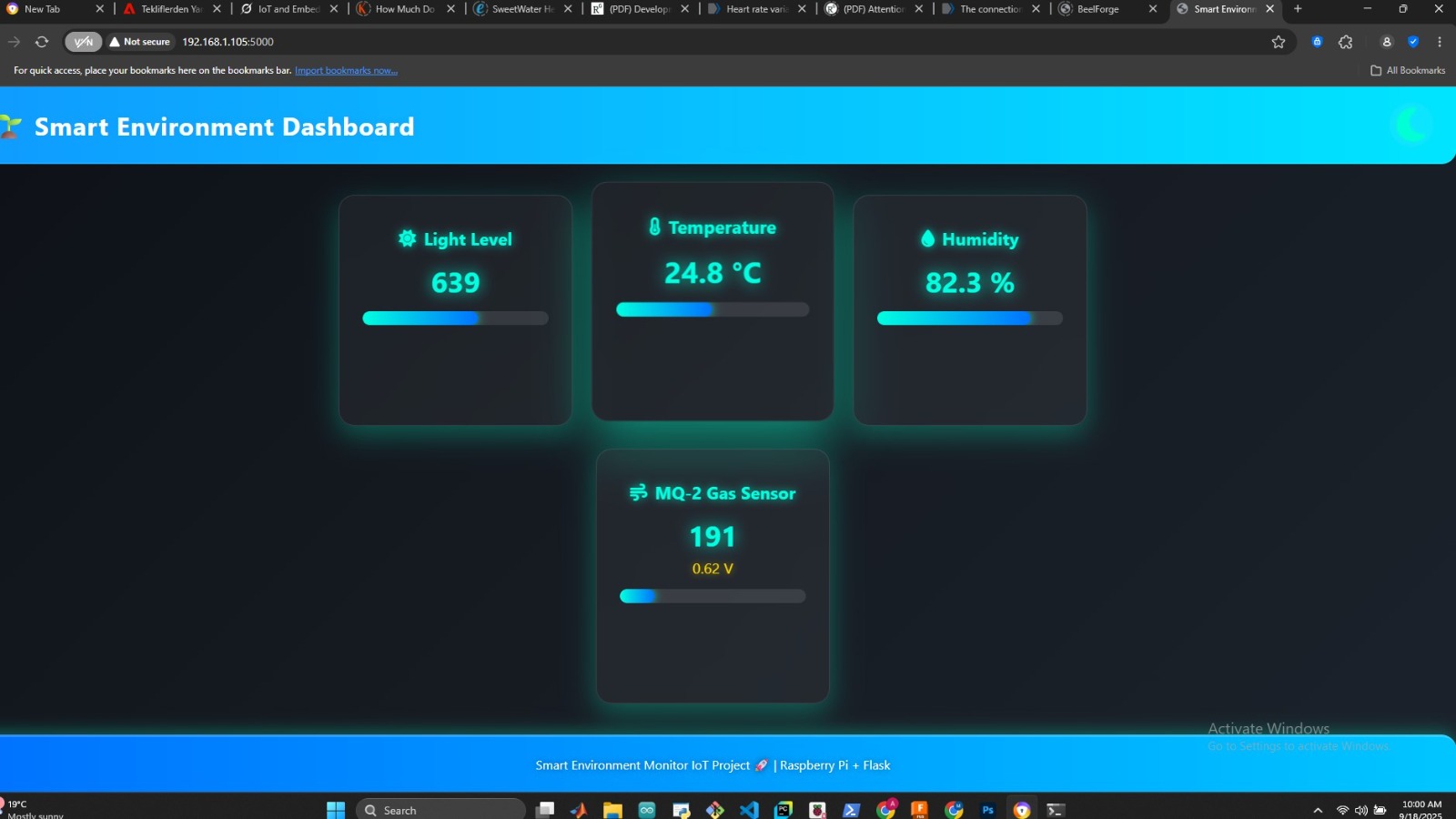
🌱 Smart Environment Monitoring System (IoT)
A real-time monitoring system combining embedded hardware, analog signal processing, and a web dashboard.
🚀 Overview
This project is an IoT-based environmental monitoring system designed to collect and display real-time data such as temperature, humidity, light intensity, and gas levels. The system combines embedded hardware with a Flask-based web interface to provide both local and remote monitoring capabilities.
Initially, the system relied only on a web dashboard. However, I extended it by integrating a 128x64 OLED display (I²C), allowing real-time data visualization directly from the device — making the system more independent and practical.

⚙️ What This System Does
- Collects real-time environmental data
- Displays sensor values on an OLED screen
- Sends data to a Flask web dashboard
- Allows remote monitoring from a browser
🛠 System Architecture
- Raspberry Pi (main controller)
- MCP3008 ADC (analog to digital conversion)
- LDR (light sensor)
- MQ-2 Gas Sensor
- DHT22 (temperature & humidity)
- OLED Display (I²C)
- Flask Web Dashboard
🔌 Understanding MCP3008 (ADC)
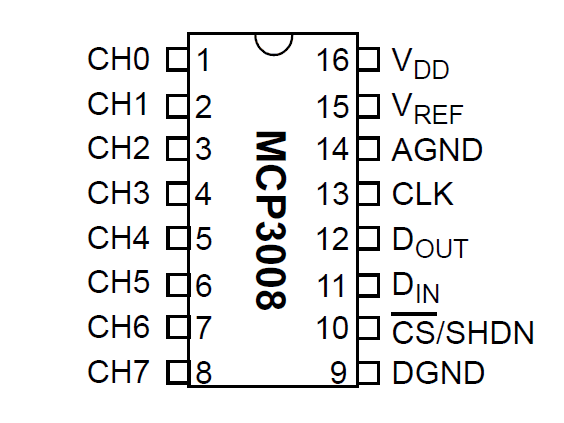
One of the most important parts of this project was learning how to work with analog signals using the MCP3008 ADC (Analog-to-Digital Converter).
The Raspberry Pi does not have built-in analog input pins, which means it cannot directly read values from sensors like LDRs. To solve this, I used the MCP3008 chip to convert analog voltage signals into digital data that the Raspberry Pi can understand.
The MCP3008 communicates using the SPI protocol (Serial Peripheral Interface), which is a fast communication method used in embedded systems.
👉 Learn more about MCP3008: MCP3008 Datasheet
- Reads varying voltage from LDR
- Converts it into digital values
- Communicates via SPI with Raspberry Pi
📡 Signal Analysis (Oscilloscope)
Here is a video On LinkedInTo better understand how the system behaves in real life, I used an oscilloscope to observe the analog signals coming from the sensors.
This allowed me to:
- Visualize how light intensity affects voltage
- Observe noise and fluctuations in signals
- Understand real-world signal instability
This step was very important because it connected theoretical knowledge with real hardware behavior.
📚 What I Learned
- How to interface analog sensors using MCP3008
- SPI communication in embedded systems
- I²C communication for OLED displays
- Combining embedded systems with web applications
- Debugging both hardware and software systems
⚠️ Challenges I Faced
- Understanding SPI communication and wiring
- Incorrect readings due to wiring mistakes
- Handling noisy analog signals
- Debugging real-time data updates in Flask
These challenges forced me to debug deeply and think like a systems engineer rather than just writing code.
📈 Improvements Achieved
- Reduced dependency on external devices
- Faster real-time data access
- Better system reliability
- Improved integration between hardware and software